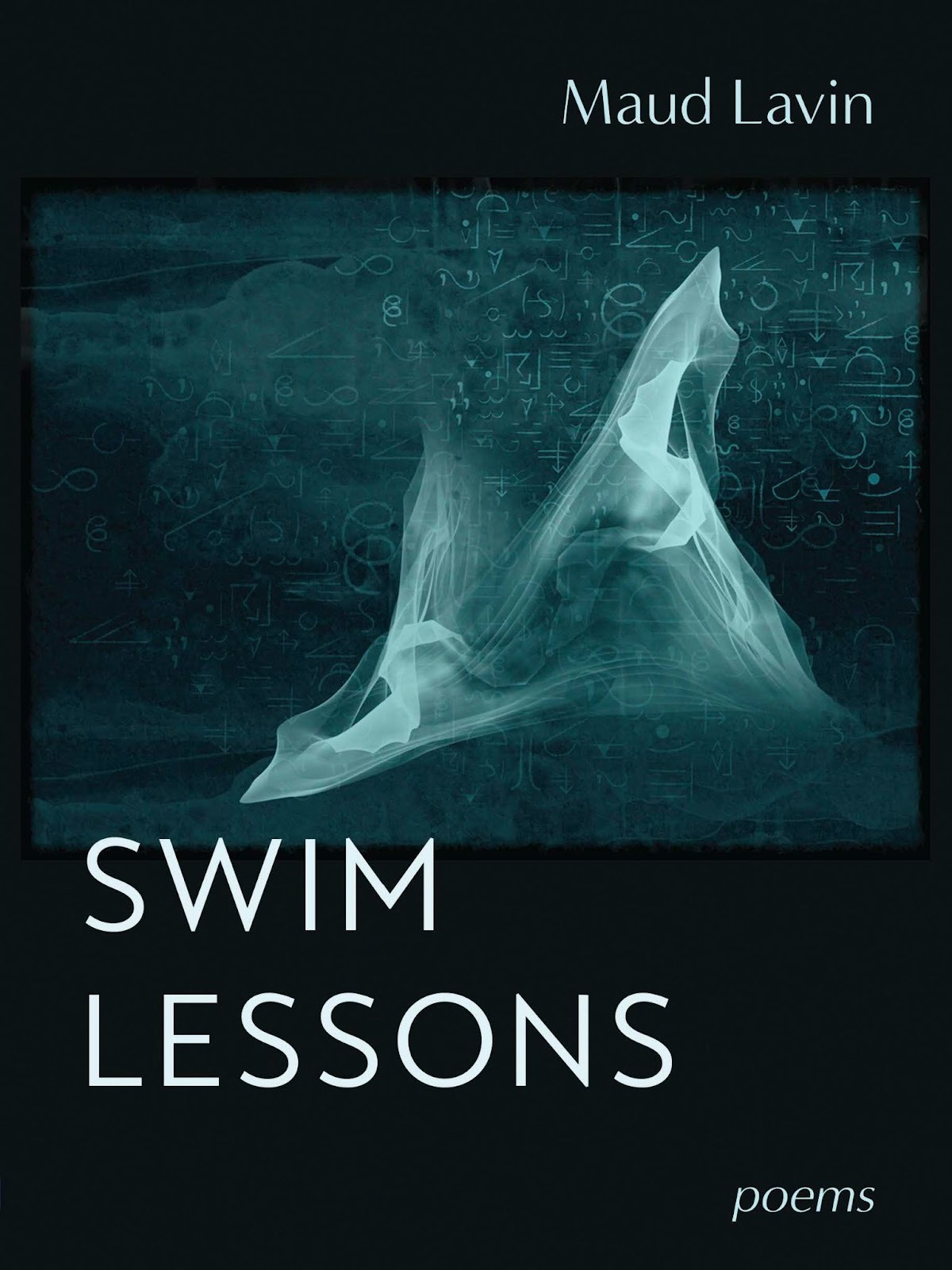
Janel: How long did it take you to write Swim Lessons?
Maud: The poems all come from what I call COVID times. There have been other poems in these years, too, but I pulled out the ones that had to do with swimming and the Lake or other flows, but they’re all from the last five years. Maybe half of them were poems I’d already written, and then the other half are new poems for the book.
Janel: It’s your first poetry book publication, but it’s not your first book publication.
Maud: It’s my ninth book, yeah.
Janel: Does it feel different publishing a poetry collection?
Maud: Hugely. It was fascinating because I come from nonfiction–scholarly nonfiction, creative nonfiction, and some books that are a meshing of the two, or what we used to call cross-over (that come from scholarly research but are written for a general audience). Poetry is so different. I mean, first of all, it’s easier for me to get into ideas than feelings. I like it because the writing of poems reminds me to be in touch with feelings. I love that whole arena, and I like listening to poets, too. That’s part of my incentive in doing my READINGS series. Well, it’s poets and prose writers, but I’m learning; that’s my MFA, running the reading series.
I’ll say one thing about putting together the poetry book, working with a poet, Lynne Ellis at Tulipwood Books who was editor—the editing on poetry is so granular. I’m used to being edited and most editors are writers, so it’s pretty congenial, and they usually help make it better and then sometimes someone doesn’t get it or is changing the meaning, but then you understand that it just needs to be more clear, so there’s a bit of back and forth. But then, exactly where you make a line break, I mean, that’s a whole level of editing that I had not really been exposed to before, so I learned a lot. I like to learn.
Janel: I can tell, and I love that about you! But you’re also a teacher, even if you’re no longer actively teaching right now.
Maud: Right, but for like all of my life, so.
Janel: One thing of interest to me was how you seamlessly moved between poetry and prose poetry, and even a lyric essay. When you’re starting a piece, do you know what genre you’ll be writing in? In general, how does that work for you?
Maud: Let me just say, this was an extremely unusual year in my writing career because I also published a novel for the first time, Mermaids and Lazy Activists, which is humorous and eco and weird, definitely weird, and has a little auto-fiction and speculative stuff. I really feel good about it, though it was very scary to write. The poetry and fiction kind-of fed each other. It’s all not nonfiction. That’s what I’m really used to writing. Then this is just like, I don’t care in poetry if something’s a prose poem or a more traditionally formatted poem, I care about the emotions, what emotions I try to convey and the sensuality. So it’s not that hard for me to break out of different poetic genres because I was never in them.
I don’t care in poetry if something’s a prose poem or a more traditionally formatted poem, I care about the emotions, what emotions I try to convey and the sensuality.
I get more inhibited during nonfiction writing because that’s what I’m trained in and that’s what I’ve taught, so this is a little bit like, ‘Oh what the hell? Give this a try.’ Not to be too corny, but there’s a kind of parallel between water and poetry, of being in the water, which I love, and being in a poem while you’re writing it. It’s kind-of wanting things to be very physical, move, and a little playful. There’s some kind of connection there.
…there’s a kind of parallel between water and poetry, of being in the water, which I love, and being in a poem while you’re writing it. It’s kind-of wanting things to be very physical, move, and a little playful.
Janel: I was really impressed with how the rhythm of your poetry was so water-like. Was there a moment or a poem that really started to inspire that music? How deliberate were you, or was it organic?
Maud: Both. Actually, one of my favorite poems in this collection is “Topology,” and it’s one of the ones that I wrote earlier on. Red Ogre Review published it. I was trying to convey this beauty and experimental nature of theoretical math where you’re kind-of swimming with your mind. You’re just imagining forms, functions and surfaces, and that is hard to convey to people who haven’t been in that headspace. Also I realized that math is so beautiful, but it’s also safe because it is so imaginary and you’re not risking yourself in a certain way. So then, as I was trying to get into that and a little bit of my past, too, that whole prose poem ends up with the idea of floating in a stream but knowing where you’re going, so that’s I think the ars poem for this collection, even though it’s an outlier because it’s not about Lake Michigan.
Janel: I highlighted “Topology” which was a little over my head, the mathematical stuff, in the sense that I had to reread it several times because I know nothing about theoretical mathematics!
Maud: Teaching math is about: can you get people involved in a way that is exciting and doesn’t just seem rote. I don’t think that math is usually taught that well. I think it’s usually taught as a sort-of punishment. It’s so much like writing in a way; you’re just making up stuff.
Janel: How do theoretical math concepts in general influence your work or perspective as an artist?
Maud: Well, it’s been so long, I haven’t been involved in math since college, but it’s really something I carry with me like a talisman, almost like this good luck charm. The experiences I had with math in college were very positive, even though I did meet up with sexism and stuff, but then there was this pleasure of vanquishing that. So it’s so long ago, but I guess it’s a confidence gift.
I haven’t been involved in math since college, but it’s really something I carry with me like a talisman, almost like this good luck charm.
Janel: What role or part does gratitude have in this collection, particularly in respect to the repetition of the Hebrew word “Dayenu”?
Maud: Well, as you know, I’m a pro-Palestinian Jew. That’s how I always define myself now, and my Jewish heritage is very important to me. Dayenu means “that’s enough” / “that would be enough.” It’s best known in this imaginary dialogue with a God during Passover. It’s saying if you’d only done this, that would be enough, if you’d only done that, that would be enough, so you’re right, it’s probably a gratitude prayer. And I lifted it for this incredible experience I had with fireflies in Ohio, I never had an experience like that with fireflies before. Just amazing. Really valleys, plural, of fireflies. So it seemed like a non-religious religious experience, beyond logic.
I’m a pro-Palestinian Jew. That’s how I always define myself now, and my Jewish heritage is very important to me.
Janel: I’ve been reading about the decline of the firefly population all over and in the Midwest. What is the significance of this poem or this memory in light of that concern—that maybe there will never be that many fireflies to be seen again?
Maud: I don’t know all the reasons for the diminishing, but this wasn’t that long ago that we had this experience. It was a very non-analytical experience: the time of day had just gone darker, darker dusk, and we were driving in Ohio. We figured out afterwards, Ohio has the largest, in population and land mass, Amish population in the United States, like larger than Pennsylvania Dutch in Pennsylvania. It’s central Ohio reaching up to Northeast Ohio, and we had gone off road, we weren’t on the highway, and we were sort-of zigzagging…In short, there were some farms that were “English,” and some farms that were Amish, and then there’s a lot of sects within the Amish. So maybe the farms where we saw a ton of fireflies were not using any poison or insecticide; they were most likely Amish farms, those valleys. There’s also, especially in the splitting up of land among a family, often family members who are next to each other. So we probably hit a valley or two of Amish farms and that’s why all of a sudden they were like a zillion. That’s an educated guess. But we were in Amish country or on the edge of Amish country, and I think that probably had to do with it, whatever fertilizers and insecticides they were using were more organic.
Janel: There seems to be a theme in the collection to do with the word “clean” and “unclean”; those words were repeated, including in “Forever Water” at the start of the book and then later in “The Body’s Water,” when you write about a time in Flagstaff. I found these to be really interesting moments and wondered about the significance.
Maud: Well, the skinny dipping in the Flagstaff reservoir (“The Body’s Water”) was of course forbidden, and it was forbidden because that’s the town’s drinking water! I assume it goes through a filtering system, but you know they don’t want animals, including humans, in there, pissing and whatever. There’s a reason they don’t want swimmers in there, and that’s it, besides liability and a lifeguard and stuff, but it’s really about keeping the water clean. And we were idiots. We were just really young and we didn’t care. Not only was it before COVID, but we thought we could swim anywhere, we were natural, the water was natural, and we didn’t really care about other people anyway—the arrogance of youth.
…we thought we could swim anywhere, we were natural, the water was natural, and we didn’t really care about other people anyway—the arrogance of youth.
Now it’s the opposite; the Chicago Park District is so wonderful, I adore them, and they always let all of us know if the bacteria is too high for swimming. So when they say green flag, we believe it, and they are really conscientious, so we jump in, and I’ve never had a rash or anything like that from swimming in Lake Michigan, so I guess they know what they’re talking about. But, you know, all kinds of stuff is dumped into Lake Michigan, and plastics, microplastics are everywhere, so there has to be a little bit of denial involved. Do you swim in Lake Michigan at all or not so much?
Janel: I’ve waded my feet in the water.
Maud: Okay, wading is also good because you’re looking out at this incredible horizon, you’re in the Lake. You know, we just want to enjoy the Lake, we’re not sitting there thinking, okay, those little minnows that I’m seeing are full of microplastics. We’re thinking, ‘Ah, it feels so good, the sun is hot, the water is cold.’ So we just lie to ourselves a little bit.
You know, we just want to enjoy the Lake, we’re not sitting there thinking, okay, those little minnows that I’m seeing are full of microplastics. We’re thinking, ‘Ah, it feels so good, the sun is hot, the water is cold.’ So we just lie to ourselves a little bit.
Janel: Throughout your book, there’s an emphasis on the importance of the cleanliness or not of water for consumption and due to pollution. In “Forever Water,” you call them, “forever chemicals.”
Maud: Yeah, that’s the thing, they’re very hard to eradicate, so they’re just always going to be there and passed on—to fish, to humans.
Janel: In “57th Street Beach” you write, “This is what the government should not do….Terrorize us.” When did you write that poem?
Maud: I definitely was thinking of the Trump administration, so it must have been during Trump 2.0, that’s the reference. I don’t think it was yet about the current version of ICE because I didn’t realize the sort of volcanic scale of this thug army that is really ruining people’s lives horribly. In general, I feel like the administration is uninterested in life and sometimes actively putting us all at risk, some more than others. It is a death cult. It is just unbelievable. As far as the Great Lakes are concerned, that was an early thing in 2.0, to try to hurry the oil pipeline along, the new tunnel that they’re building, which is unproven and dangerous. I mean, basically it’s a pro-pollution administration. That was probably on my mind because that’s something they started pushing really early. And on the other hand, we have the wonderful Chicago Park District, which is just amazing. 57th Street Beach used to be a little more treacherous, they have built up the sand. You get in the water and there’s a lot of kids there, and there’s a long sandy shelf under the water, so you can really walk out pretty far, and that’s true with the other major Chicago beaches, too. Great lifeguards, the Park District also keeps the beach clean from the usual litter that humans create, cigarette butts and whatever. I adore the Park District. Now I swim in laps at a Field House, which is part of the Park District. Fantastic, I love them. The government’s supposed to serve us, right? Like libraries, park districts. This is our Lake. Yeah, little parts of the Lakefront are private, but in Chicago, it belongs to all of us. It’s amazing, right?
Janel: It is. You’ve definitely made me see all the ways to appreciate it. I also loved your poem, “When the What Ifs Turn Into Now.” What was your inspiration for this piece and in what ways do you hope it speaks to other writers?
Maud: Well, that poem is also about being older. I’m 70 now, and I think I wrote it when I was about 67. It definitely dawns on you at some point in the gray hair age that you don’t have forever, so it’s like, fuck this and that, which drive me crazy and let me try to get A and B, live in a state of B, I’m mortal. So part of it is most definitely about that, and I retired earlier from teaching than I had been planning on because of COVID, but then it’s like, okay, this is it! This is it. Then, it’s also for people of different ages, too, and especially in this extremely fraught and dangerous time in U.S. history; it’s like, maybe we won’t always be safe. Maybe we won’t always be able-bodied. We might as well… It kind-of reminds you of what the priorities are. And about U.S. history, there have been other bad times, too, but it’s a kind-of a recurrent theme of life being hard, and so then, what do you actually want to do with it, or how do you want to enjoy it? This is pretty pleasure-oriented.
Janel: How close have you come to making the what-ifs “nows”?
Maud: I’m a worrier. I worry a lot about things outside myself and in my own life, so I get caught up in that stuff and then I have to sort-of transport myself into, you’re already 70. I would say about writing, I like to set new challenges for myself, so I have started another poetry book, I think, but I’m a little bit stymied by it because I set up a new challenge, so also this is why your questions are so helpful to me because I’m thinking, okay, in the new thing, remember gratitude, remember pleasure. I’m trying to get to empathy in the new one because all these people who run the country don’t have any empathy, so I guess there’s things coming from outside that make things hard, and things that come from inside because we set up challenges, so this is a good reminder that it takes some doing to return to this ‘if not now, when?’ kind of mentality because I’ll wake up in the middle of the night and worry about things… I have to, I want to remind myself to keep myself oriented that way.
Janel: Maybe that’s just what it means to be human.
Maud: Yeah, we can’t always be happy. But it’s the silver lining for mortality, you know, that we get to at least try to do what we want because we don’t have forever.
It’s the silver lining for mortality, you know, that we get to at least try to do what we want because we don’t have forever.
Janel: It really goes back to “Topology,” where we’re not static, so imagine ourselves just twisting about…
Maud: Yes, exactly, yeah, we get to flow, we get to wonder, and make shit up. I like to make stuff up.