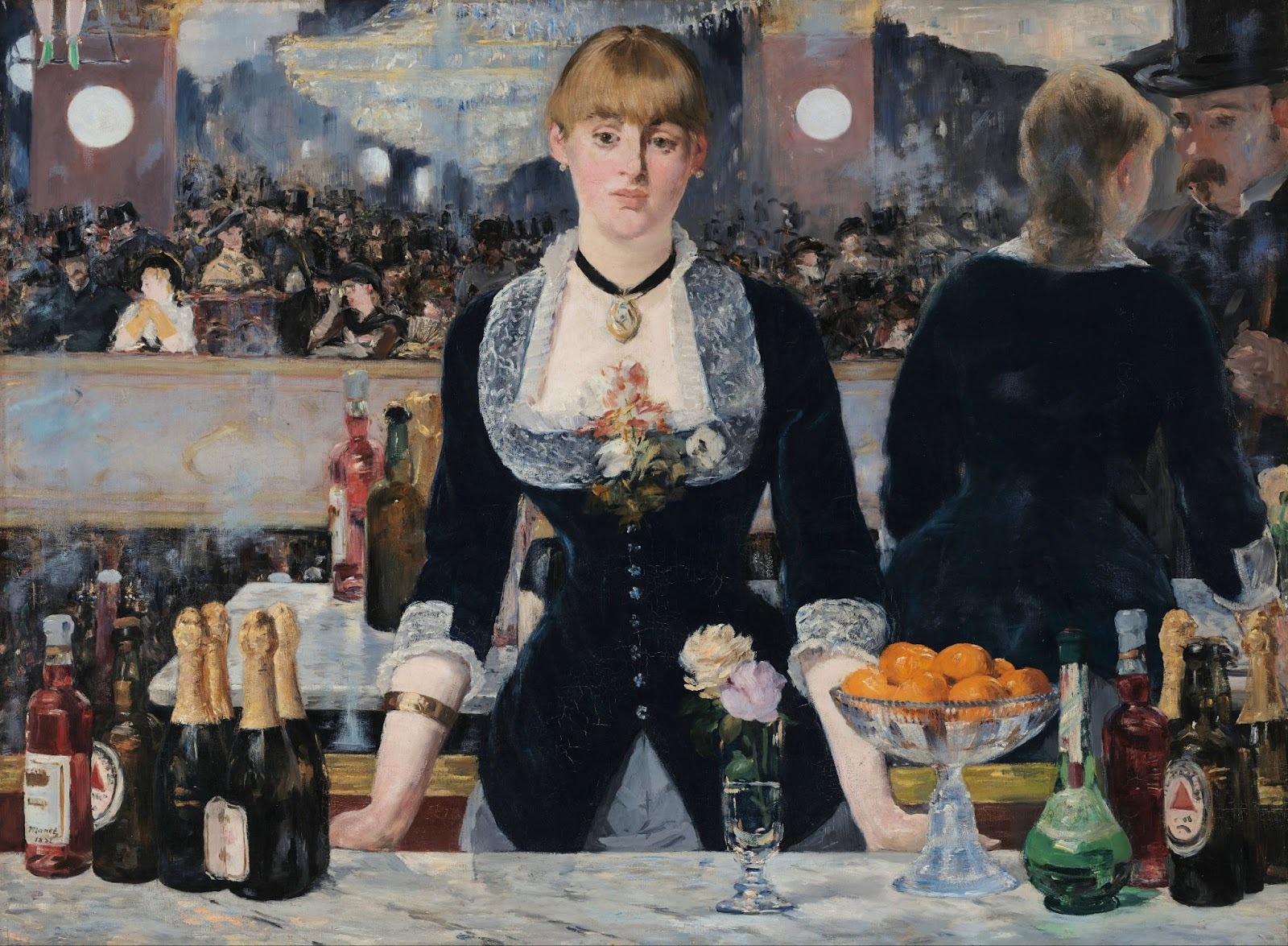
I heard someone say / barmaids don’t usually make it into portraits / he was talking about ‘A Bar at the Folies Bergère’ / you’ll know it as soon as you Google it / full of champagne and the trickery of mirrors / he meant / in that time / in that place / as if it’s different today / but don’t we all know / a barmaid is someone whose eye you catch / and then discharge / like a used tissue / as soon as she puts down your dripping pint
A barmaid knows / you can tell so much by how someone drinks / whether they open their throat / or sip and peer slyly over the rim / in the painting / you have to wonder at her reflection / it’s in the wrong space / back more bent / hair more loosely styled / and there is a man / with a silver topped cane / maybe that’s why she flushes / and grips the marble counter / to stop herself / floating into his chaos
The bar is a blur of people / their top hats and faces / ugly and glossy / just smears of paint / so we can see them without seeing them / except for one woman / her shoulder draped with a man’s hand / ivory profile clean as new sheets / she clasps her hands together / as if she’s praying / for an angel shot / or a way to step out of her time / into ours / where women can say no / supposedly
In the corner of the canvas / dangling over the in-crowd / like a childhood memory of wonder / a pair of legs in green booties / a trapeze artist swinging through the beveled space / half existing / a moonbow / too diminished to excite / she is given less attention / than the bowl of glacé mandarins on the bar / waiting to be bitten by any passing man / gentle or not
All these odd and end women / small works / pinned down under glass / and like any man / Manet was good with glass / look at the crème de menthe bottle / cool and green and inviting / or his world in a mirror / stretching into infinity / or just into tomorrow / where we women / are still incidental / or praying our date is a decent man / or where in the worst case scenario / we are just a pair of disembodied legs
Adele Evershed
Three Questions for Adele
What inspired your choice of genre and/or form for your work?
I've always loved visiting art galleries and museums, and I saw A Bar at the Folies Bergère at The Courtauld Gallery in London a couple of years ago. I didn't notice the legs in the painting's corner then, but when I later saw them in my photo, it acted as the catalyst for the poem. The painting is full of women, with the barmaid front and center, and others distinctly painted in the crowd. The men are more distorted, appearing as reflections in the mirror or shadowy figures. I wanted to use something created over a century ago to highlight the dangers women still face.
What was your creative process?
When I write ekphrastic poems, I always start by brainstorming any words or feelings the painting evokes. I have completed a couple of online courses with Ekphrastic Review, which suggested engaging all the senses so that the poem resonates viscerally. I make columns for each sense, noting at least one word under each, then move to a rough draft. From there I refine it, looking for patterns and connections. After that, I do additional research on the artwork to see if I can use any historical or contextual details in the poem. I'm always trying to create a conversation between the past and present, to show how things change and how they remain the same.
What is the significance of this work to you?
I often write about violence against women. I have a daughter, and while society has progressed in recognizing and naming sexual abuse, she still faces a lot of misogyny and inequality that I faced at her age. In "Sellers of Consolation," I was looking to give a voice to the overlooked women. The French poet Guy de Maupassant described the barmaids at the Folies-Bergère as "vendors of drink and of love," and I thought that was such a male view. It romanticizes someone who serves you drinks as someone who is there to offer affection too. It’s not surprising, then, that some men internalize this view, and rejection can escalate to violence. I hope this poem reflects on the past and examines the present, showing how women still face many of the same threats and judgments.
Adele Evershed is a Welsh writer who swapped the Valleys for the American East Coast. Her work has appeared in Poetry Wales, Modern Haiku, The Ekphrastic Review, Atrium, and Literary Mama. Adele has two poetry collections, Turbulence in Small Spaces (Finishing Line Press) and The Brink of Silence (Bottlecap Press). Her third collection, In the Belly of the Wail, is forthcoming with Querencia Press. She has published two novellas-in-flash, Wannabe and Schooled(Alien Buddha Press), and has a third, A History of Hand Thrown Walls, forthcoming with Unsolicited Press. Her short story collection, Suffer/Rage, was recently released by Dark Myth Publications.