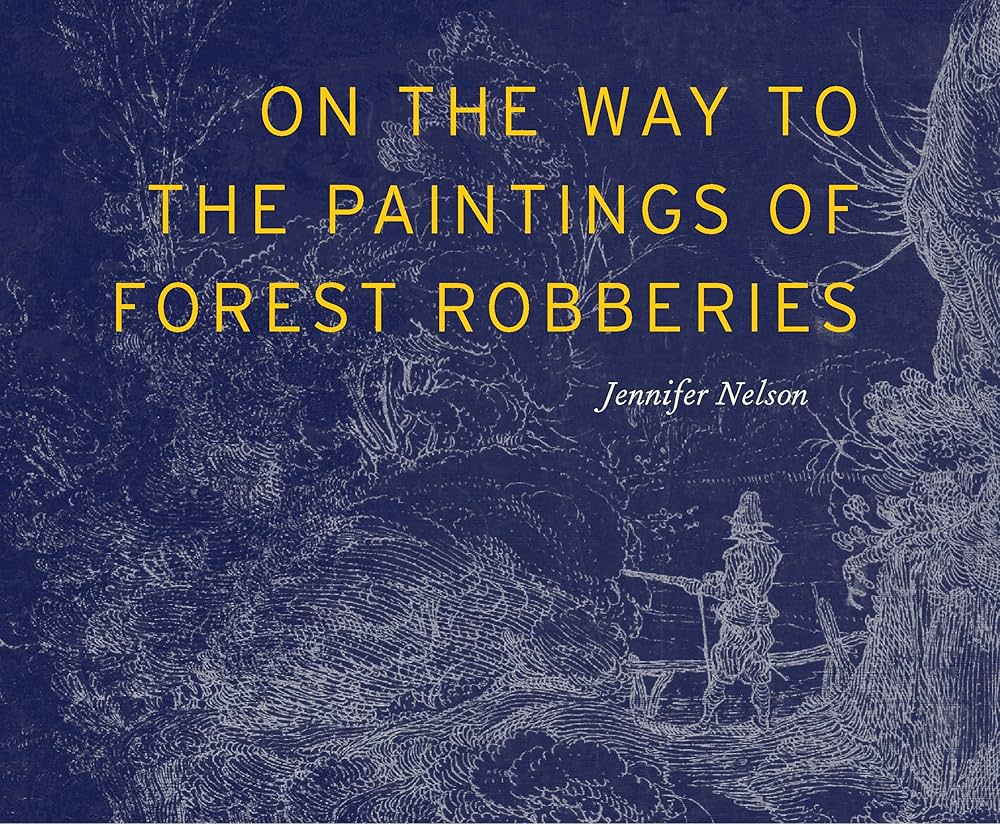
Selected for the 2024 Ottoline Prize by Fence Books, On the Way to the Paintings of Forest Robberies was written by Jennifer Nelson, an historian of early modern art and an associate professor at the University of Delaware. In 91 pages, On the Way to the Paintings of Forest Robberies is acerbic in its scope, ranging from discussing sixteenth century paintings, documents of colonization, Christendom, crusades, plague and contemporary numbness to human suffering, among other subjects. Overall, Nelson paints a picture of Filipino grief and anger surrounding the long history of colonization and imperialism under so-called ‘divine right’ and capitalism.
Before I descend too deep into the forest here, I want to explain a bit about the book’s hybrid forms. First of all, this collection mostly consists of ekphrastic poetry, or poetry based on artwork or that channels from visual culture and art history at large. The first section of this collection also consists of hermit crab poems, or poems that take on the identity or visage of another type of textual form. In the case of this first section, it is based on the form of a tenure dossier. Finally, the design of the book is landscape. Holding the book in your hands feels like an unraveled scroll, or a landscape painting from the sixteenth century.
When it comes to organization, the book is split into three sections: 1. Tenure Dossier, 2. Ekphrases, and 3. Primordial Tide Pool. But before these sections is a sonnet that serves as an entry point into the collection, referring to it as “the loam on the forest floor, / the ongoing of the unremembered / and those remembered wrong.” It is a poem that questions how speaking out for “the unremembered / and those remembered wrong” will undo the harm done throughout history to many populations seeking shelter in their homeland. This is a thread that returns throughout: what can be done to avoid glorifying suffering as ‘beautiful’ in art and in real life, and how much protesting is enough protesting? Without the context of the three parts, this can be a daunting entry point, but after reading the collection, it is very satisfying to return to it with newfound clarity.
As I mentioned before, the first section, called Tenure Dossier, is a grouping of nine hermit crab poems that mimic the form of an application for tenure as a professor. The poems are named after different application components, like “Condition for Retention,” “CV,” “Statement of Future Plans,” and “Optional Statement on ‘Engaging with Diverse Communities.” The bureaucracy of applying for tenure is one way of entering Nelson’s perspective as an art history professor that relates to their concerns surrounding the ripple effects of colonialism and bureaucracy on contemporary life.
The longest poem of the collection, titled “Writing Sample: The Boxer Codex,” is in the first section, and it introduces themes of colonization of East Asia at the hands of Spanish colonizers. “Writing Sample: The Boxer Codex” is ekphrastic in the sense that The Boxer Codex is a real document: it is a sixteenth century Spanish manuscript made in the Philippines which includes illustrations of people from various areas of East Asia made by an anonymous Chinese artist and commissioned by the Spanish colonizers. The time The Boxer Codex was made coincides with the beginning of Spanish colonization of the Philippines. “Writing Sample: The Boxer Codex” is the only poem in the collection to consistently take advantage of the width of the book design, dilating between wide description and concise poetic language. The poem ends with a call for focusing on native populations in research and depiction, and not relying on the lens of colonization to see said populations. The speaker “await[s] the verdict / through the accurate / tongue of the last bird, / who has no reader.”
The second section, titled Ekphrases, includes many ekphrastic poems based on European art, ranging from ancient Greek to early modern. Many of the poems in this section criticize crusades, colonization, and seizing of lands. The poem “Burn the Banner of the King,” written after David Jones, contains this amazing line: “Isn’t this how / to be kind / while destroying everything?” which speaks to colonization as the ulterior motive of the ‘friendly explorer.’ Poems in this section get closer to the colonial monster that steals land and reigns foreign laws over native populations that never asked for that. The third section of this collection, Primordial Tide Pools, reminds us that this monster is not just colonial: it is also contemporary. Nelson’s poem, “My Mark of the Beast / Poem about the Octopus,” confronts the current moment from the angle of our fears of protest, especially surrounding Palestine. As if returning to “Sonnet” in the beginning of the collection, “My Mark of The Beast / Poem about the Octopus” returns to the sordid relationship between beauty and suffering, but complicates this conversation with both information and hope being depicted as the cause for this parallel, despite their necessity for moving forward. Within this, the suggestion to change our relationship to information and hope becomes abundantly clear, the change being to bring action into our practice of protest.
The final poem of the collection, “On First Looking into Me I Got Some Savonarola,” contains some of my favorite images throughout the whole collection. In it, Nelson talks about the demon monster of colonization as a wall without a face, and relates the people and scholars of the world to doors that let us past the wall. The double meaning of “orient” throughout this poem is apparent, meaning both changing one’s orientation in relation to something and also referring to “The Orient,” an outdated, Eurocentric term for the East. This poem suggests that learning colonial history through early modern art allows us to break patterns of historical trauma, and enter the “echo of abundance” that is pure and true freedom from oppression.
Thinking about On the Way to the Paintings of Forest Robberies as a whole, I did find myself wishing that more poems utilized the full width of the book’s aspect ratio, like “Writing Sample: The Boxer Codex” did. That poem demonstrated an excellent unity between book design and poetic form. With that being said, the book design did not take me out of the rest of the poems, which were filled with history and kept me invested even if I wasn’t familiar with the subject matter. There were times when I wished there was an index or a glossary, but only so I could get an even fuller grasp of Nelson’s definitions and interpretations of their ekphrastic subjects. In the end, On the Way to the Paintings of Forest Robberies depicts the sheer weight of suffering that human history has encrusted onto itself, and affirms the role of the scholar as one of inciting protest and instilling necessary historical revisionism into the masses.
(Thank you to Fence Books for the ARC of On the Way to the Paintings of Forest Robberies by Jennifer Nelson! It was a pleasure to review.)