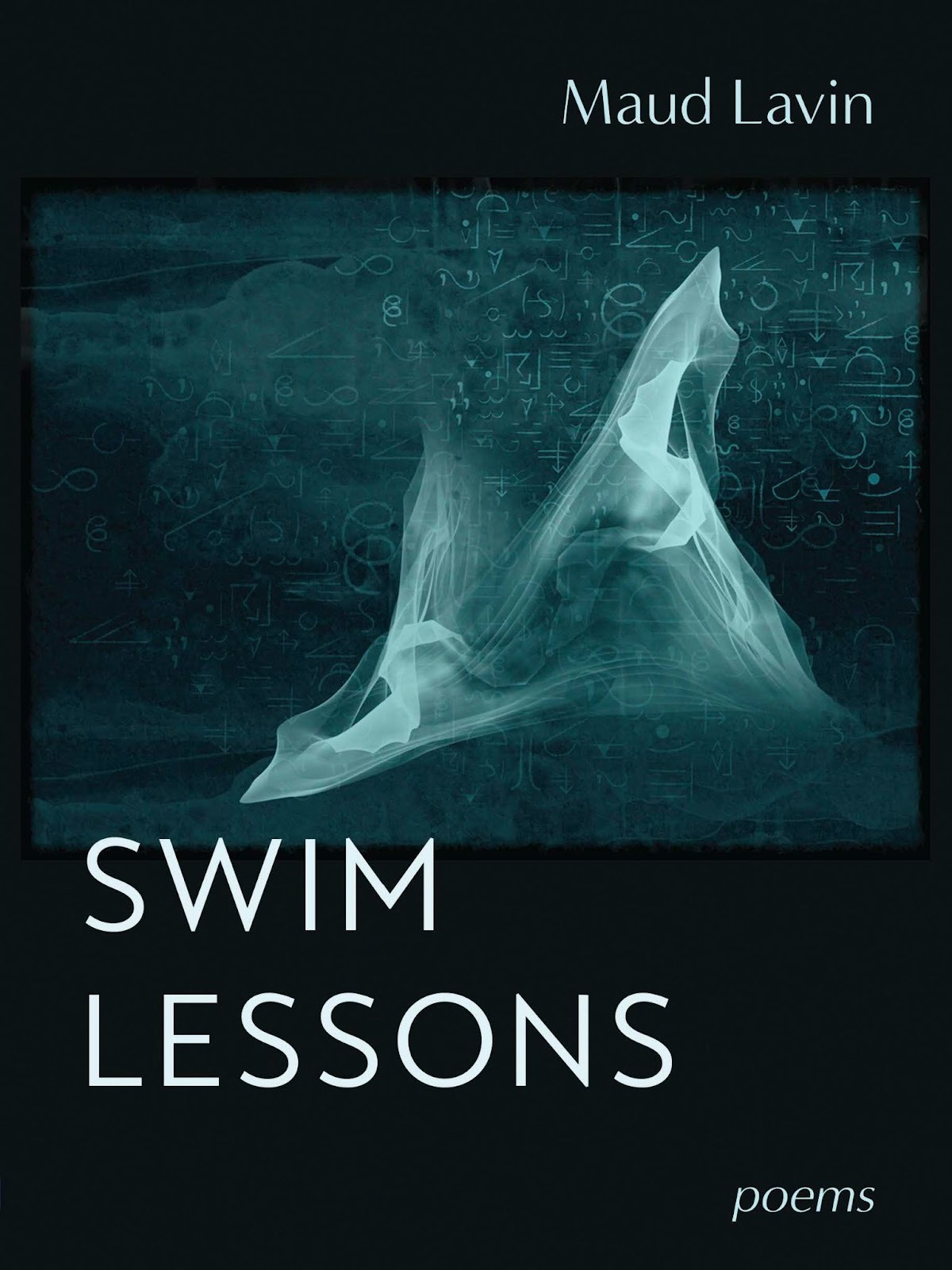
Swim Lessons (Tulipwood, 2025) is Maud Lavin’s debut poetry collection and ninth book. A life-long writer, professor, and beloved Chicago community READINGS organizer, Lavin’s collection reflects her love and care for Lake Michigan, Chicagoland, and its communities through poetry, prose poetry, and the lyric essay. The book explores swimming adventures, teaching mathematical theory, driving through valleys of fireflies on road trips to Ohio, and more—flying, being in love, growing older, and living one’s best life. Lavin expresses gratitude for moments of joy in what have been difficult times that have repeated throughout history. Within the fluidity of poetry and prose poetry, Lavin expresses the freedom to feel, experience, and flow, much like when swimming: “it’s poetry, / a place to feel, not an obligation to explain.” Feeling and embodiment, through both the human body and bodies of water, act as forms of knowledge and resistance. Across the collection, Swim Lessons frames collective care, ecological attention, and lived joy as essential to survival.
Examining the symbolism of water, in “The Tarot,” Lavin writes about the Page of Cups. The card, traditionally associated with emotional openness and intuitive beginnings, resonates with the theme of maintaining joy in an unstable world. The musicality of her language reinforces these themes through lulling, wave‑like rhythms, such as in: “Forever water, my water, our water, freshwater” (“Forever Water”). Shifting from “my” to “our” water, the repetitions highlight a belief in shared resources and responsibility, insisting on communal care.
“Clean” and “unclean” is an important repeated duality in the book. In “Forever Water” (“I feel the water as clean though I know it’s not”), Lavin describes Lake Superior as the cleanest water ever or “forever seen,” but even that water has “forever chemicals.” The knowledge of “forever chemicals” thus changes the speaker’s relationship to the water and to oneself. This raises the question: can sensory pleasure coexist with ethical awareness? In another example, “Bodies, Water” in the section “Flagstaff Reservoir,” Lavin writes: “We summer staffers are in our 20s and it doesn’t occur to us that our bodies could be unclean” when the young adults decide to go skinny‑dipping in the town’s reservoir. The collection repeatedly emphasizes the importance of water’s cleanliness—or lack of—for consumption and the harm of contamination due to pollution. Even the beloved Lake Superior is full of microplastics; the poems acknowledge all of this, yet encourage us to keep swimming while maintaining a perspective of awe and gratitude.
Other poems that broaden a sense of wonder and depth of noticing include “Fireflies, Ohio,” and “Flying.” In “Fireflies, Ohio,” the speaker describes driving down into a valley and seeing a magical scene of fields upon fields full of fireflies, “more beautiful than the Grand Canyon under moonlight.” She brings us into this setting with fascination. “Flying” is a playful prose poem about imagining doing extraordinary things, and then discovering complications that would arise if it became reality. Its humor emphasizes a recurring theme: imagination as escape and rehearsal for risk.
“When the What Ifs Turn Into Now” is a carpe diem poem, an ode to life and an instructional on living one’s best life. Switching the point of view to “you” at the end invites fellow writers to turn ‘what ifs’ into ‘now.’ The poem and collection invites writers to Chicago, deepening the connection with the Seder tradition of leaving a place set for Elijah, which is alluded to in “Dayenu.”
In “57th Street Beach,” Lavin first describes a postcard for Chicago: “God Bless the Chicago Park District,” it says. Not afraid of the political poem, Lavin continues with, “This is what the government should do…” followed by “This is what the government should not do….Terrorize us.” Here, the contrast between the Chicago Park District and federal policies sharpens its critique through paradox: the government is capable of supporting public joy and public space, while it is also capable of terrorizing its own residents and undermining the Great Lakes through pro‑pollution agendas.
“Topography,” the ars poetica of the book, explores the idea of preservation versus change under dynamic conditions. The shape is “transformed…like a story,” just as we are never static. The poem has us imagine ourselves twisting about, flowing, wondering, and making things up, contemplating the state of change and (im)mortality with lines such as “the figure holds, even while it transforms, it still exists” and “Everything changes, but still it lasts.” The connection to theoretical math becomes a metaphor for how Lavin approaches language and life: as something to play with, test, and reshape without losing its core.
Like little love letters, her collection makes you fall in love with Chicago’s Great Lake—it beckons you to dip your feet in during one quiet Chicago summer not too far from now. In “To Fall Back in Love with the Midwest,” the collection ends with the speaker sitting on a park bench talking with neighbors, which feels distinctly ‘Chicagoan’: “figuring together how we’re going to survive.” That last image ties up the book’s major threads—community, ecology, and resistance. To survive, it suggests, we must not despair, but lean into collective action.
Swim Lessons seamlessly weaves between prose and poetry with vivid, adventure-filled images that evoke wonder and understanding. Lavin looks at the world with a careful, critical eye, irony and tongue‑in‑cheek humor, and most of all, with love and hope that the things we share, the things we love, we will continue to fight for. If the history of oppression repeats itself, so does resistance, and thus its importance never wavers. Swim Lessons is a piece of resistance, an ode to place and imagination, to conscious gratitude over hopelessness, and to our continued survival—together.